
Does Your Book Start in the Right Place?
I read a lot of books – for work and pleasure – and recently edited two that made my brain itch in completely different ways.
One opened with a whole chapter of morning routine, right down to which toothpaste the protagonist used, and the other had so much exposition that I felt as though I’d known the main character my entire life – and there was nothing left to explore or be revealed.
We’ve all done it, written a book that starts in one of the ways considered a cliché. I’m an author, and I’ve done it too, so you’re not alone.
Or maybe you’ve picked up a book you think will be great, only to get bored by Chapter 2 because nothing has really happened.
And readers want something to happen. They want to be gripped from your opening sentence.
Ask yourself… Will your line about Norman getting out of bed and feeding his fish really capture their imagination?
So, I suppose you want to know what those clichés are, right?
Okay then, well, let’s go. (And please, don’t come at me, I’m not saying all of these are bad, or that great books can’t start this way. But if your story opens with something that a reader has read a hundred times before, or an agent sees fifty times a day, you might want to rethink that for something more unique.)
The Clichés:

The inciting incident doesn’t happen until Chapter 4.
By which time, you’ve lost the reader, the agent, and the only thing still interested is the cat – and their sole objective is to roll around on anything you might be looking at anyway.
A whole chapter of info-dumping and exposition. The character's life story, right there at the top. I mean, do we really need to know his toilet schedule before we even know his name?
The protagonist wakes up. Unless they’re rudely awoken by something exciting and majorly plot-related, maybe start somewhere else.
It was all a dream. (Often combined with the waking up cliché.) Chaos, drama, disaster… and then they wake up. Sometimes this is even prophetic – which means your reader is already expecting what’s to come.

The ‘it was a normal day’ start.
Ask yourself whether your reader needs to know (or will care) that your main character sat at their desk for five hours, had a tuna sandwich for lunch (at that same desk), or photocopied 700 pages of data reports.
A very busy group scene packed with dialogue. Who’s talking? Who are these people? Your reader has no idea – and often doesn’t want to stick around to figure it out.
Love at first sight. I’m a romance writer… I love a bit of love – sometimes even instalove – but maybe, just maybe, starting with BAM! ‘I love him, I’m going to marry him’, could make the reader question your protagonist’s grip on reality.
Staring into a mirror. The whole reflective self-contemplation where your protagonist spends hours (okay, paragraphs) analysing their life can really affect pacing and delay narrative progress. Contemplate life, by all means, but make it interesting. Often, this gets combined with the next offender…
Overly descriptive passages. Your reader doesn’t need to know everything about your character and your setting right there in the first three paragraphs. If by the end of Chapter 1, we know their eye colour, hairstyle, every freckle, tattoo, and wrinkle, favourite cereal, chair, season, and their postcode, it might be too much.
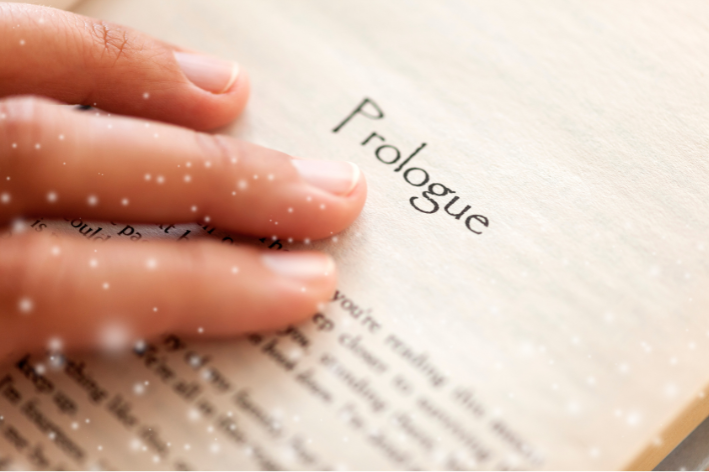
A prologue.
Now we wander into really divisive territory. Some love them, some hate them. Ask yourself if it’s really necessary, or whether the information could be woven into the story instead.
Of course, this list isn’t exhaustive. There are others, and again, these aren’t always bad. Some of the best books we’ve ever read, bestsellers even, have started with one of these. But when you write your opening, think about how to hook your reader. Make it original.
So, Where Should Your Story Start?
The elements that make something interesting for me are conflict, tension, stakes, and change. If something is out of the ordinary, and it shows us what your character wants, then, in all likelihood, that’s where I’m going to want to start.
But don’t obsess over it. Write your story first; your true beginning will be in there somewhere. That’s what editing (and people like me) are for.
Just remember: although your story feels vivid and exciting in your head, it has to translate onto the page and keep readers engaged. Keep them interested, and they’ll not only enjoy your book, they’ll come back for the next one too.
Want to make sure your opening grabs your reader from that very first line? Check out my Chapter One Checklist: Make sure your story starts where it should. Get it here, along with the ever-growing collection of resources for writers aiming to hook those readers from page one.